

Filter en sorteer
Klantbeoordeling Henzen

Excellent!
Zoals altijd snelle levering. Produkt als omschreven. Topverkoper!
ik ben heel tevreden keurig geleverd en goede kwaliteit
Nice coin. Well packaged. Good accompanying description.
MA-ID: 8796802010
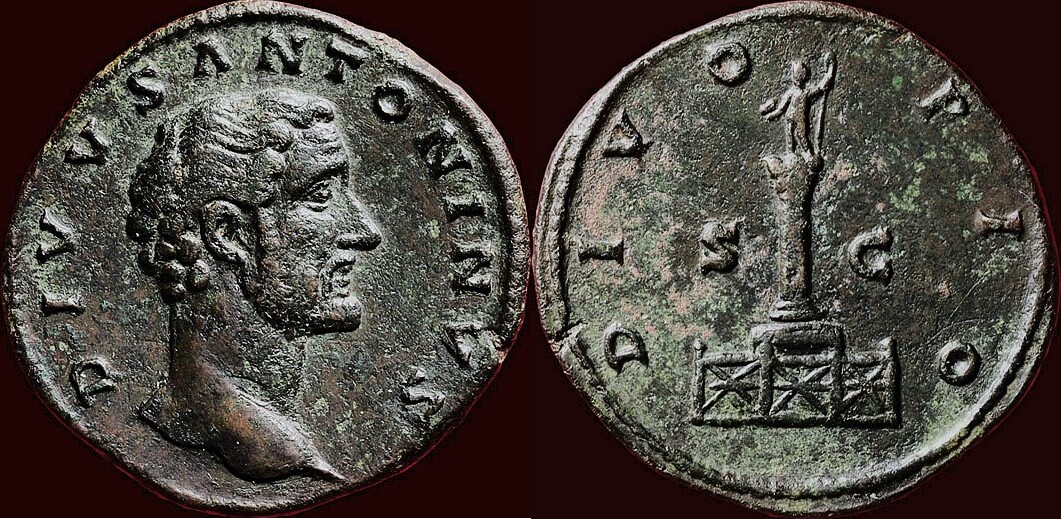
Roman Empire AE Sestertius 138-161 n. Chr. ANTONINUS PIUS, 138-161 - Rome vf/xf
Munthandel G.Henzen 
11
Verkoper op MA-Shops sinds 11 jaar
8138 Beoordelingen,
100 % Positief (Laatste 24 maanden)
975,00 EUR
BTW: Margeregeling
Excl. 11,00 EUR Verzending ( to Nederland )
Levertijd: 2 - 3 dagen
| bestelhotline +31 (0)6 8317 0586 |
| Betaalmethoden |
| Overboeking |
vf/xf | Afkortingen
32,00 mm
weight 21,36gr. | bronze Ø 32mm.
obv. Head of Antoninus Pius, bare, right,
surrounded by the legend DIVVS ANTONINVS
rev. Corinthian column set on base and surmounted by statue of
Divus Antoninus, S - C across fields, surrounded by the legend
DIVO PIO
The Column of Antoninus Pius was erected in Rome to commemorate Antoninus and his wife Faustina by his adoptive sons and heirs, Marcus Aurelius and Lucius Verus after the emperor′s death in 161. It stood in the Campus Martius near the Column of Marcus Aurelius and the commemorative altars of the Antonines. The column is shown on coins surmounted by a Corinthian capital and a statue, presumably of bronze, and a balustrade. The column itself was 14.75 metres high and 1.9 metres in diameter and was constructed of red (Aswan) granite, with no decorating reliefs as on the otherwise similar columns of Trajan and Marcus Aurelius. A fire in the eighteenth century severely damaged the shaft and its undamaged parts were used to repair the Montecitorio Obelisk (originally the Obelisk of Horologium Augusti). An inscription on the slab indicates it was quarried in 106, probably for one of Trajan′s great projects but never used. When it was excavated in 1703, around six meters of the column projected above ground. The excavations exposed a richly sculpted pedestal made of a single block of Italian marble (28 m³), now located at the Vatican Museums. The inscription on the base records that Antoninus Augustus [Marcus Aurelius] and Verus Augustus dedicated the column to the Divine Antoninus Pius (their adoptive father). The central relief, opposite the dedicatory inscription, shows the Apotheosis of Antoninus and Faustina. They are borne aloft on the wings of a genius figure, sometimes identified as Aion, and flanked by eagles. At the lower corners are the goddess Roma, who lifts her hand in salutation, and a personification of the Campus Martius, a genius reclining on the ground and holding the Obelisk of Horologium Augusti. The reliefs on the sides, intended to be identical, show the decursio equitum performed at the funeral before the pyre was lit. Riders of several sorts, including senators, move in a ring around a group of foot soldiers representing the praetorian guard. From the formation of Rome to the mid-2nd century AD cremation was the more common method after somebody died. In the event of cremation, the body was taken to the necropolis (″city of the dead″) and put upon a funeral pyre. It was then burned, and the ashes and remaining fragments of bones and teeth were interned in a funerary urn. It was believed that until the body was interred, the ″shade″(spirit) had not crossed the River Styx yet (the river that takes one from the World of the Living to the World of the Dead). Thus, there was a sense that the psychic impression of the deceased still lingered around friends and family, and the spirit would become angered if anything negative was said about it. After the mid- 2nd century AD inhumation (or burial) eventually took over as the preferred method. The body would be placed inside a coffin, called a sarcophagus, which was often massive and richly decorated. The body was not buried with any possessions. This was a very old practice throughout the Mediterranean, but one that was hardly ever used in Rome, especially when cremation was the most common method.
After the death of an Emperor, he would be buried inside the city. This was an honor reserved for only the most exceptional and illustrious people most Romans had to be buried outside of the city. It was also believed that Emperors did not become shades (spirits) like others did rather, they became Gods through a process known as apotheosis. As such, the Emperor′s commemoration was much more impressive and more expensive monuments were erected. Trajan′s Column, under which the Optimus Princeps′ ashes were buried, is one of the most well-known Roman monuments. Cohen 354 | RIC 1269 | BMC 880 | MIR 46 | Sear 5199 R
Attractive greenblack patina. Good portrait. Rare.
vf/xf
Respecteer a.u.b. het door ons gehanteerde bestelminimum van 20 euro. Verzending vindt plaats binnen 5 dagen na ontvangst van betaling. Zendingen naar China zijn voor risico van de koper en alleen betaling mogelijk door bankoverschrijving. Aan PayPal en creditcard betalingen zijn altijd administratie- en risicokosten verbonden. Zendingen naar Rusland, Oekraïne en Israel zijn niet mogelijk. Voor landen binnen de EU betalingen graag UITSLUITEND MET IBAN; snel, goedkoop en betrouwbaar.


|
hier de overeenkomst herroepen Startpagina van de MA-SHOP | 0Winkelwagen | Algemene verkoopvoorwaarden | Contactgegevens | MA Algemene verkoopvoorwaarden | Privacybeleid | Garantie | MA-Shops Nieuwe artikelen Copyright ® 2001-2026, MA-SHOPS Coins All Rights Reserved. Designated trademarks and brands are the property of their respective owners. |