

Filter en sorteer
Klantbeoordeling Henzen

Excellent!
Zoals altijd snelle levering. Produkt als omschreven. Topverkoper!
ik ben heel tevreden keurig geleverd en goede kwaliteit
Nice coin. Well packaged. Good accompanying description.
MA-ID: 8067702010
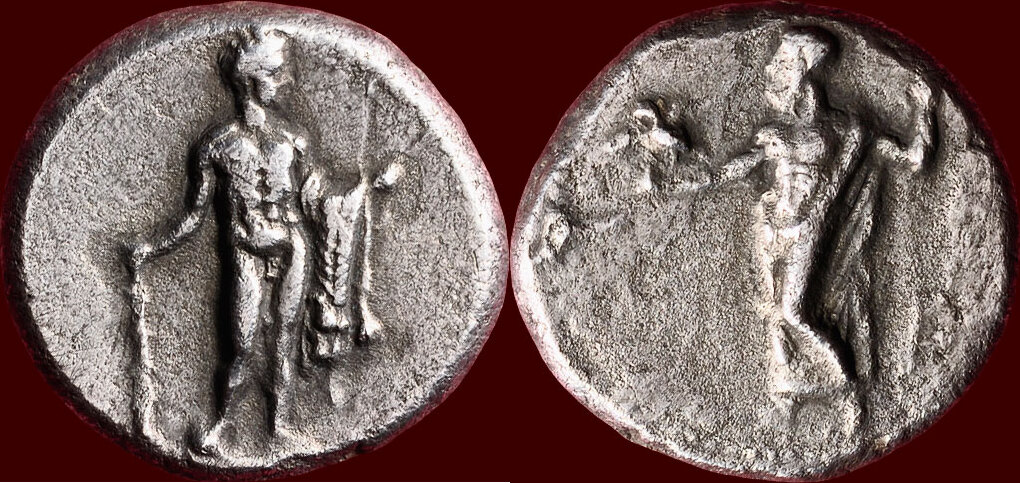
AR Stater 386 - 380 v. Chr. CILICIA, ISSOS - TIRIBAZOS, SATRAP, 386-380 BC - 386 - 380 BC vf/vf-
Munthandel G.Henzen 
11
Verkoper op MA-Shops sinds 11 jaar
8138 Beoordelingen,
100 % Positief (Laatste 24 maanden)
2150,00 EUR
BTW: Margeregeling
Excl. 14,00 EUR Verzending ( to Nederland )
Levertijd: 2 - 3 dagen
| bestelhotline +31 (0)6 8317 0586 |
| Betaalmethoden |
| Overboeking |
vf/vf- | Afkortingen
19,00 mm
weight 9,77gr. | silver Ø 19mm.
obv. Hercules standing right, leaning lefthand on club,
and with lion-skin draped over right arm
rev. Baäl standing left, holding eagle and scepter The history of Issos goes back to the Neolithic age, about 5000 BC the Hittites called the place Izziya. The city was strategically located on a spit of land in the Mediterranean Sea, at the head of the Gulf of Issos, not far from the Syrian border. In the history, the town was famous for the battle of Issos, 5 and 6 November 333 BC, when Alexander the great defeated the Persian King Darius III. The city lost much of its importance after the foundation of Alexandreia ad Issum, south of Issos. The city was abandoned around 50 BC, probably after an earthquake.
Tiribazos was born ca. 440 BC. He made a career as a military man and served as a satrap under the Persian King Artaxerxes II (450-358 BC). He was highly regarded by Artaxerxes II, and when he was present, so Xenophon tells us, no one else had the honour of helping the sovereign to mount his horse. Until 395 BC, Tiribazos served as the hyparch (satrap) of Western Armenia. He succeeded Tithraustes as satrap of Western Asia (Sardis). He was holding this office when, in 393 BC, Antalkidas was sent to negotiate, through him, a peace for Sparta with the Persian king. In 387 BC he also led the peace negotiations with Athens, which which led to the Peace of Antalkidas. In 386/385 BC, Tiribazos was made joint commander of the Persian expedition against Evagoras I (r. 411–374 BC), the king of Salamis in Cyprus. He was assigned to the lead the Persian navy, while Orontes I, the satrap of Armenia, led the land forces. Tiribazus reportedly knew Orontes from his early days in Armenia, where he had served as the hyparch of its western part till 395 BC. By 382 BC, preparations for the campaign had been made, with a battle taking place the following year near the Cyprian city of Kition, where the Persians emerged victorious due to their larger fleet. Evagoras withdrew to Salamis, which he started fortifying. Failing to gain help from the Egyptian pharaoh Hakor (r. 392/1–379/8 BC), Evagoras started to negotiate a peace treaty with Tiribazos, offering to withdraw from all the cities of Cyprus except Salamis, and pay a fixed yearly tribute to the Persian crown. Tiribazos was inclined to accept the offer, but the negotiations failed after Evagoras refused to also cede his status as king. The negotiations between Evagoras and Tiribazos led to Orontes to send a number of accusations to Artaxerxes II, which mentioned that Tiribazos was deliberately prolonging the war and planning to declare independence. Artaxerxes II was unable to make a proper assessment due to his distance, but could not risk Tiribazos ruin the recent Persian accomplishments, and as a result had him jailed in Susa, heavily weakening the position of the Persian expedition. Glos, who was the father-in-law of Tiribazos, fearing for his own position, started plotting against Artaxerxes II and secretly making peace with Egypt and Sparta. Evagoras started to help from the Spartans and gave Glos information that would jeopardize Orontes′ position. Under the threat of blackmail, Orontes was forced to make peace with Evagoras in 380 BC. The terms of the treaty was that Evagoras was obligated to pay tribute to the Persian king, but as a subordinate king rather than a slave. Artaxerxes II did not deem the conclusion of the war satisfactory, as it had cost 15,000 talents, and a result Orontes fell into disfavour. Meanwhile, Tiribazos was pardoned and restored to his former position.
Tiribazos now stood higher than ever in the royal favour, and received a promise of the hand of Amestris, the king′s daughter. Artaxerxes, however, reneged on this arrangement, and married Amestris himself. When ca. 370 BC King Artaxerxes reneged on a pledge to Tiribazos once more, this time with respect to Atossa, the youngest of the king′s princesses, Tiribazos could no longer remain loyal to the king and incited Darius, the son of Artaxerxes, to join him in a plot against the king′s life. Tiribazos′ plans were betrayed to Artaxerxes by a eunuch, and the conspirators were found out. Tiribazos offered a desperate resistance to the guards who endeavored to arrest him, and was slain with a javelin. Tiribazos had a son, Arpates, who later killed Artaxerxes′s favored son, Arsames. BMC- | SNG.Paris 418 | SNG.von Aulock 5603var. |
SNG.Levante 174var. | Sear- RRR
Some minor roughness on reverse. Extremely rare.
vf/vf-
Respecteer a.u.b. het door ons gehanteerde bestelminimum van 20 euro. Verzending vindt plaats binnen 5 dagen na ontvangst van betaling. Zendingen naar China zijn voor risico van de koper en alleen betaling mogelijk door bankoverschrijving. Aan PayPal en creditcard betalingen zijn altijd administratie- en risicokosten verbonden. Zendingen naar Rusland, Oekraïne en Israel zijn niet mogelijk. Voor landen binnen de EU betalingen graag UITSLUITEND MET IBAN; snel, goedkoop en betrouwbaar.


|
hier de overeenkomst herroepen Startpagina van de MA-SHOP | 0Winkelwagen | Algemene verkoopvoorwaarden | Contactgegevens | MA Algemene verkoopvoorwaarden | Privacybeleid | Garantie | MA-Shops Nieuwe artikelen Copyright ® 2001-2026, MA-SHOPS Coins All Rights Reserved. Designated trademarks and brands are the property of their respective owners. |